The Hudson County Court is a key component of the New Jersey judiciary, serving Hudson County residents who search for reliable court and case information. It functions within the statewide court system of New Jersey, which follows uniform judicial rules across New Jersey. The court handles a broad range of legal matters that impact daily life across the county. Many users search this court to identify case types, court divisions, and judicial responsibilities. This page focuses on delivering clear, search-focused information tied to Hudson County Court queries. It supports users seeking accurate context about how county courts operate in New Jersey.
The hudson county court nj operates under the authority of the New Jersey judiciary, with defined procedures for filings, hearings, schedules, and case records. Court activity includes civil disputes, criminal matters, and Hudson cases managed through structured divisions. Residents, legal professionals, and record researchers frequently rely on this court for official case flow details. Court processes follow statewide judicial standards to maintain consistency across New Jersey counties. Publicly available court information promotes transparency and informed case review. This introduction establishes topical relevance for users searching for Hudson County Court information online.
What Is the Hudson County Court System?
The Hudson County Courts operate within New Jersey’s unified judicial framework and serve as local trial-level courts. The New Jersey Hudson County Court functions under the statewide NJ Judiciary and manages a wide range of legal matters.

Placement Within New Jersey’s Judicial Structure
Hudson County forms part of the broader court system in NJ, which follows a single statewide model rather than separate county systems. This structure places administrative control with the New Jersey Supreme Court, creating consistency across counties. Hudson County belongs to Vicinage 5, a regional grouping used by the judiciary to organize courts, assign judges, and manage case flow. Vicinage 5 links Hudson County with nearby jurisdictions for administrative purposes.
This arrangement supports uniform court rules, shared resources, and standardized procedures. Residents still file cases locally, yet the courts operate under the same authority and rules used statewide. The Hudson County courts sit at the trial court level. Trial courts hear cases at their starting point, review evidence, and issue judgments based on New Jersey statutes and court rules. Appeals move to higher courts after a final decision at this level.
Trial Courts Serving Hudson County
The Superior Court of New Jersey, Hudson Vicinage, stands as the main trial court. It handles serious legal matters and divides work by case type. This structure helps court staff and judges manage cases efficiently and keeps proceedings organized.
Primary divisions include:
- Criminal Division – indictable offenses and felony-level charges
- Civil Division – lawsuits involving damages, contracts, or property
- Family Division – divorce, custody, support, and juvenile matters
- Probate Part – wills, estates, guardianship, and related filings
Municipal courts operate within Hudson County cities and towns. These courts hear traffic cases, ordinance violations, and lower-level criminal charges. Each municipal court serves a local area, yet all follow statewide rules set by the NJ judiciary structure.
Search Hudson County Court Records & Case Information
Users can search Hudson County court records online or in-person to find case information, dockets, and filings. Knowing the correct search method helps ensure accurate results while following legal and privacy rules.
How to Search Hudson County Court Records
Performing a proper Hudson County court case search starts with knowing what information to use.
Users should have at least one of the following:
- Full name of a party involved
- Case number
- Filing date or date range
The main types of cases available for search include:
- Criminal cases – charges, hearings, and verdicts
- Civil cases – lawsuits, claims, and judgments
- Family cases – divorces, custody, and domestic matters
- Probate cases – wills, estates, and guardianships
- Small claims – disputes under county monetary limits
Using specific search terms like “Hudson County criminal case lookup NJ” or “Hudson County civil case docket search” improves accuracy. Public court records in New Jersey are structured so that each search returns case summaries, filing histories, hearing dates, and results.
Where to Access Hudson County Court Records
There are multiple ways to view Hudson County court records, either online or at the courthouse. Access options vary in cost, depending on whether users are viewing, downloading, or requesting certified documents.
NJ Courts Public Records Online
- Case Types: All case types (criminal, civil, family, probate, small claims)
- Cost for Viewing: Free
- Cost for Downloading / Copies: Free PDF download
- Access Method: Online
- Website URL: https://www.njcourts.gov/
How to Use the New Jersey Courts Attorney Search Portal
- Visit the Official New Jersey Courts Website
Open the official New Jersey Courts website by going to njcourts.gov using your web browser.
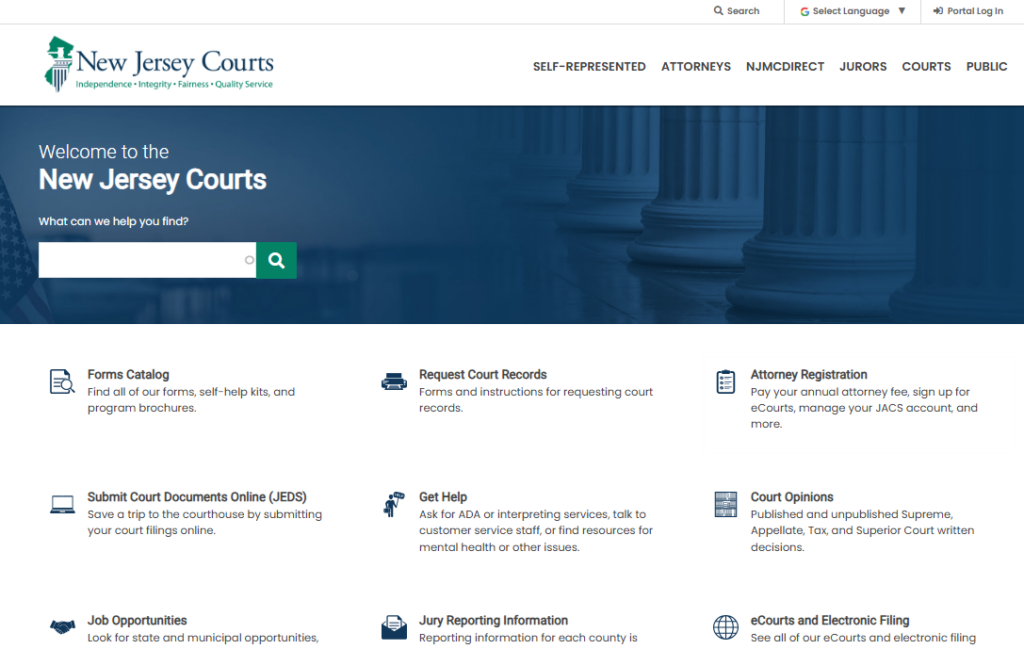
- Click on “Portal Log In”
On the homepage, locate the Portal Log In option, usually found at the top of the page, and click on it to proceed.
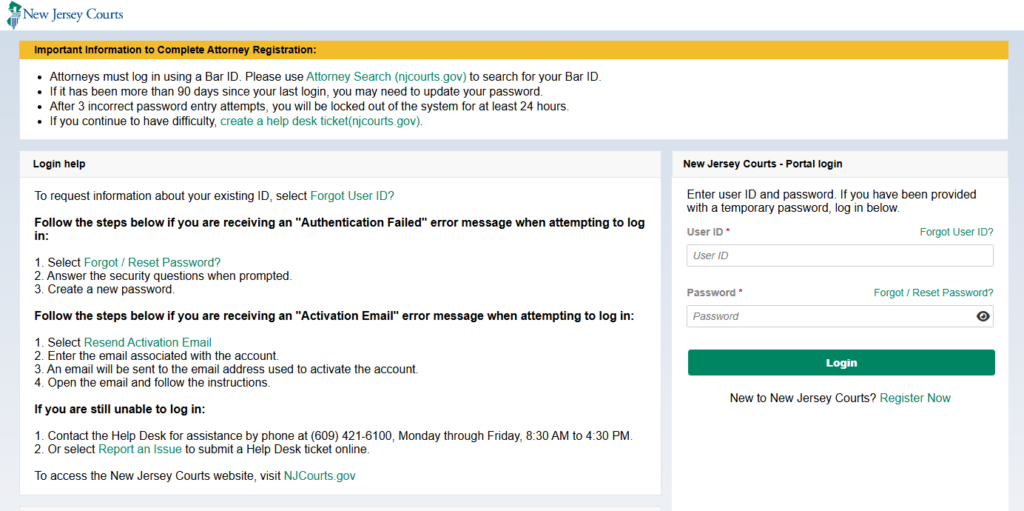
- Access the Attorney Search Page
After the portal page opens, look at the top section of the page and click the linked text labeled Attorney Search (njcourts.gov).
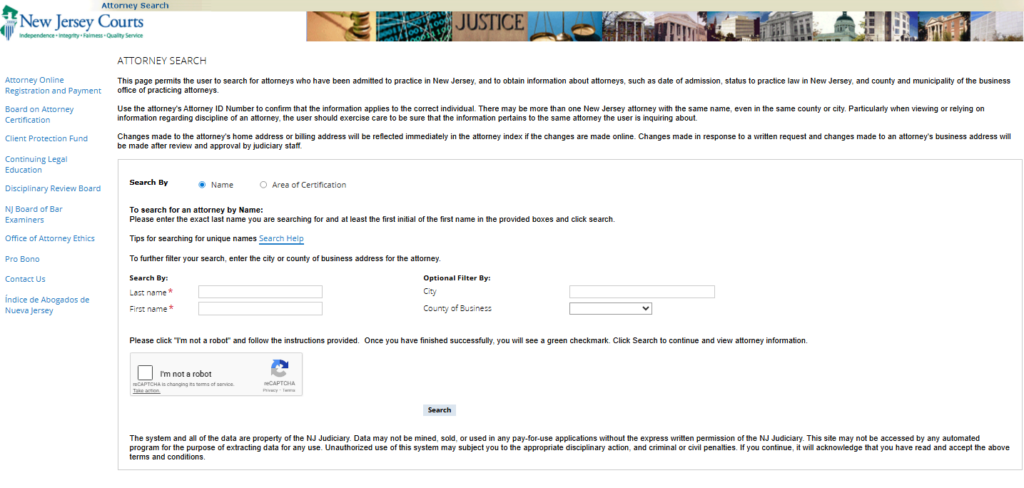
- Search for an Attorney
The Attorney Search page allows users to look up attorneys by name, license number, or other available search criteria. - Review Attorney Information
Search results may include attorney status, registration details, and other publicly available information as provided by the New Jersey Courts system.
This platform allows users to search by full name, case number, or date range. Results include case summaries, docket entries, and filings.
Hudson County Clerk’s Office
- Case Types: Civil, Small Claims
- Cost for Viewing: Free
- Cost for Downloading / Copies: $0.50–$1 per page
- Access Method: In-person / Online
- Website URL: https://www.hudsoncountyclerk.org
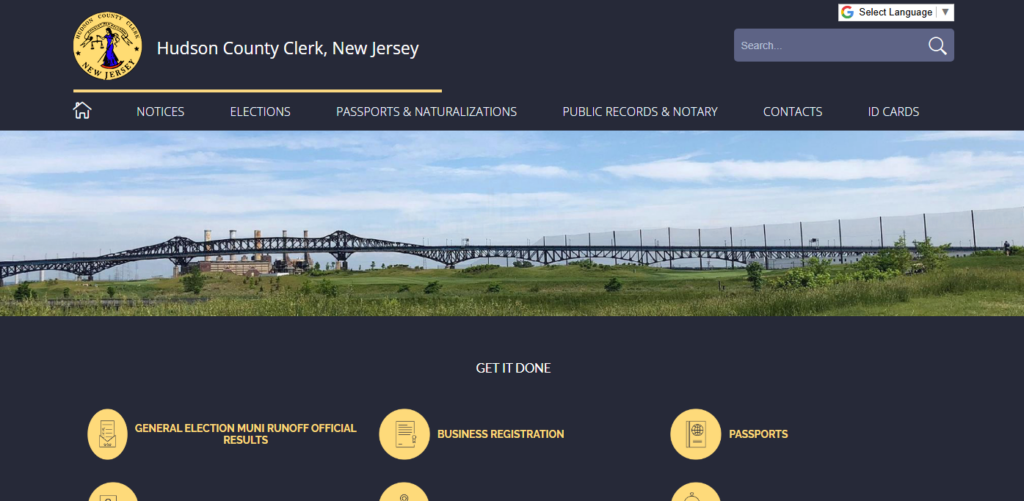
The Clerk’s Office provides public terminals and staff assistance. Certified copies of documents can be requested for a small fee.
Hudson County Superior Court
- Case Types: Criminal, Family, Probate
- Cost for Viewing: Free
- Cost for Downloading / Copies: $2–$5 per document
- Access Method: In-person
- Website URL: https://www.njcourts.gov/courts/
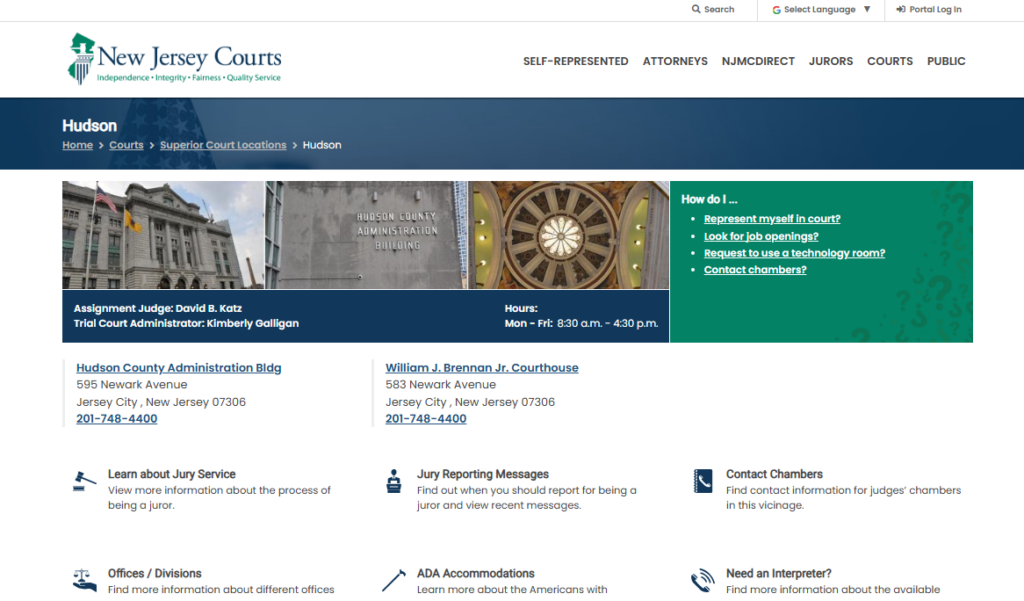
At the Superior Court, users can review dockets and filings with clerk assistance. Some sensitive records may be restricted for privacy reasons.
- Online portals: NJ Courts and county-specific sites allow immediate access to case summaries and dockets. Users can search by name, case number, or date range.
- In-person access: At the Hudson County Courthouse, public terminals and clerk assistance are available. Users can request certified copies for a fee.
Tips for Accurate Searches
- Always enter the full name to avoid multiple unrelated results.
- Include the case number if known, which speeds up the search.
- Use date ranges to narrow down filings for longer-running cases.
- Respect privacy rules: some records, like juvenile or sensitive family cases, are restricted.
Using the proper search methods and understanding cost structures ensures users can efficiently locate the right Hudson County court records without confusion. Whether online or in-person, following these steps provides a clear path to accurate case information.
Common Case Types Handled by Hudson County Courts
Hudson County courts handle a broad range of cases, from criminal offenses to family disputes and small claims. These courts provide a structured environment where legal issues are addressed according to New Jersey law.
Criminal Cases
The criminal court division in Hudson County manages cases involving violations of state law, including misdemeanors and felonies. Typical cases include theft, assault, drug offenses, and traffic violations. Each case begins with an arraignment, followed by hearings to review evidence, and, if necessary, a trial where guilt or innocence is determined.
Sentencing may include fines, probation, or imprisonment, depending on the severity of the offense. Hudson County courts coordinate with prosecutors, defense attorneys, and law enforcement to ensure cases progress efficiently while protecting the legal rights of defendants.
Civil Disputes
Civil cases in Hudson County courts involve disagreements between individuals, businesses, or organizations. These disputes often relate to property, contracts, or personal injury claims. The court process begins when a plaintiff files a complaint, and the defendant responds with their side of the story.
Most civil cases involve a discovery process, where both parties exchange evidence and documents to support their claims. While some disputes are resolved through settlement, others proceed to trial, where a judge issues a final decision. Civil courts also encourage mediation to help parties reach agreements outside of lengthy court proceedings.
Family and Probate Matters
The family court in Hudson County handles sensitive cases such as divorce, child custody, child support, and domestic violence. The court carefully evaluates each case to protect the welfare of children and ensure fair outcomes for families.
Probate matters, including wills, estates, and guardianships, are also managed by these courts. They ensure that assets are distributed according to state law and that guardianship responsibilities are assigned appropriately. Family and probate cases often involve multiple hearings to address complex personal and financial issues.
Small Claims
Hudson County small claims courts provide a simpler and faster way to resolve disputes involving limited amounts of money, typically under $3,000. The process is informal, allowing individuals to represent themselves without hiring an attorney.
Small claims hearings are designed to reach resolutions quickly, often in a single session. Winning parties may receive a court order for payment, giving residents a practical way to settle minor financial disagreements without extensive legal procedures.
Types of Courts in Hudson County, New Jersey
Hudson County courts operate through several court divisions that handle criminal, civil, family, and local matters. These trial courts follow the Superior Court NJ structure and municipal court system used across the New Jersey judiciary.
The Hudson County court system gives residents clear paths for resolving disputes, criminal charges, and local violations. Each court division has defined duties, set case limits, and specific locations, which help the public know where a case belongs and what to expect.
Hudson County Superior Court
The Hudson County Superior Court serves as the main trial court for serious legal matters. It handles higher-level cases that require formal hearings, judges, and detailed procedures under the Superior Court of New Jersey framework.
This court hears a wide range of cases, including:
- Criminal cases, such as indictable offenses and felony-level charges
- Civil litigation, including contract disputes, personal injury claims, and property matters
- Family matters, like divorce, child custody, child support, and domestic violence cases
The Superior Court operates through divisions that focus on case type rather than location. Criminal, Civil, and Family divisions each follow their own court rules, filing steps, and hearing schedules. Judges preside without juries in some matters, yet jury trials remain common for serious criminal and civil cases.
Municipal Courts in Hudson County
Municipal courts in Hudson County handle local-level cases tied to cities and towns. Each municipality operates its own court, though some towns share services through joint municipal courts.
Municipal courts typically hear:
- Traffic violations, including speeding, parking tickets, and license-related offenses
- Ordinance cases, such as noise complaints, zoning issues, and local code violations
- Minor disorderly persons offenses and municipal-level charges
These courts focus on quicker hearings and simplified procedures. Most cases get resolved without juries, and many matters conclude in a single appearance. Fines, points, community service, or short-term penalties often apply, depending on the violation.
Specialized & Trial Court Divisions
Hudson County courts include specialized trial court divisions that focus on specific legal needs. These divisions operate under the Superior Court NJ system, yet they follow procedures designed for their case types.
Key divisions include:
- Family Court, handling custody disputes, child support, adoption, and domestic relations
- Probate, covering wills, estates, guardianships, and estate administration
- Small claims, designed for lower-dollar civil disputes with simplified filing and faster resolution
Family court cases often involve sensitive issues, so privacy rules apply more strictly. Probate matters focus on asset distribution and legal authority after death or incapacity. Small claims court offers a faster option for resolving limited financial disputes without complex litigation steps.
Hudson County Court Within New Jersey’s Judiciary
Hudson County Court is part of New Jersey’s trial court system, handling civil, criminal, family, and municipal cases. It operates under the state judiciary framework, ensuring that legal matters are resolved fairly and efficiently.
As one of New Jersey’s trial courts, Hudson County Court serves as the first point of contact for most legal disputes in the region. It handles a wide range of cases, including traffic violations, small claims, divorces, and felony charges. The court ensures that proceedings follow the court system NJ protocols, providing a structured process for hearings, filings, and judgments.
Structure and Function
The court is organized into several divisions to manage different types of cases:
- Criminal Division: Handles indictable offenses, arraignments, and criminal trials.
- Civil Division: Deals with disputes between individuals or businesses involving money, contracts, or property.
- Family Division: Oversees divorces, child custody, support, and domestic violence matters.
- Municipal Court: Addresses minor offenses, traffic tickets, and local ordinance violations.
Each division follows clear procedures defined by New Jersey trial courts, ensuring that cases move from initial filing to resolution efficiently. Judges and court staff work together to schedule hearings, manage dockets, and maintain compliance with state laws.
Role in the Judiciary
Hudson County Court operates within New Jersey’s court system, linking municipal courts with higher appellate courts. Decisions made here can influence case outcomes at the Superior Court or Appellate Division levels. By providing accessible services, timely case management, and transparent procedures, the court helps maintain public trust in the local justice system.
Jersey City Courthouse and Its Role in Hudson County
The Jersey City Courthouse serves as a central hub for many legal proceedings in Hudson County. It handles a wide range of cases, from civil disputes to criminal trials, and supports the county’s judicial system efficiently. As the primary location for Hudson County trial courts, the courthouse plays a critical role in maintaining legal order in the region. Located in downtown Jersey City, this facility houses multiple court divisions, including civil, criminal, and family courts. Residents often visit for hearings, filings, and other court-related matters, making it a key point of contact for both attorneys and the public. The courthouse also collaborates closely with the Superior Court location to ensure cases are scheduled and processed accurately.
The Jersey City Courthouse is equipped with modern courtrooms and administrative offices. Visitors can find resources for jury duty, legal forms, and case inquiries, which help streamline the legal process. For example, criminal cases are managed in dedicated courtrooms with experienced judges and staff, ensuring timely trials and hearings. Family court matters, such as custody or support disputes, are handled with privacy and care, emphasizing fair resolution.
Key Features of Jersey City Courthouse:
- Multiple Divisions: Civil, criminal, and family courts all operate under one roof.
- Accessible Location: Downtown Jersey City with public transit nearby.
- Support Services: Jury duty information, legal forms, and case assistance.
- Superior Court Coordination: Works in tandem with Hudson County’s main trial courts.
By serving as a central venue for legal proceedings, the Jersey City Courthouse ensures that residents of Hudson County have reliable access to justice. Its role in coordinating with other county courts strengthens the overall efficiency of the judicial system.
Hudson County Courthouse & Jurisdiction
The Hudson County courthouse system manages legal matters for residents and businesses across the county. Each courthouse location serves specific types of cases, ensuring that legal processes are handled efficiently and in the proper setting.
Hudson County features several courthouse buildings, each responsible for different court functions. The Jersey City courthouse, for instance, primarily handles civil, criminal, and family law cases under the Superior Court of New Jersey. This building also accommodates specialty divisions, such as probate and matrimonial matters. Meanwhile, smaller municipal courthouses across the county focus on traffic violations, local ordinance issues, and minor criminal cases. By organizing courts by case type, Hudson County ensures that cases are processed effectively and in the correct legal venue.
Major Courthouse Functions
Each courthouse serves distinct purposes depending on the case type:
- Superior Court, Hudson County: Handles serious civil lawsuits, criminal indictments, family court issues, and probate matters.
- Municipal Courts: Manage local ordinance violations, minor traffic offenses, and low-level criminal cases.
- Specialty Divisions: Some courthouses offer tax court sessions or environmental law hearings, providing focused attention for specific legal areas.
This division helps residents know where to file cases or attend hearings, reducing delays and improving court efficiency. For example, someone with a civil lawsuit should visit the main Hudson County courthouse, while traffic ticket disputes typically go to a municipal court nearby.
Court Locations in Hudson County
While each building has a specific jurisdiction, all work together to serve the county’s legal needs. Some key points about courthouse locations include:
- Courthouses are distributed across cities such as Jersey City, Hoboken, and Bayonne to make access easier for residents.
- Each courthouse lists its hours, departments, and services online, allowing people to identify the right location for their legal matter.
- Certain courthouses host multiple divisions in one building, like civil and family courts, to centralize complex case types.
By clearly defining the roles of each courthouse, Hudson County makes it easier for residents to handle legal matters without confusion. Knowing which courthouse handles which cases can save time and ensure hearings or filings occur at the correct location.
How the Court Process Works in Hudson County
The court process in Hudson County follows a structured path from filing a case to resolving it. Each step involves specific procedures that ensure fairness and compliance with New Jersey law.
Hudson County courts handle both civil and criminal matters, and every case moves through a trial court process designed to maintain clarity and order. The case lifecycle typically begins with the initial filing, where plaintiffs or prosecutors submit complaints or charges. After filing, the court schedules preliminary hearings to address procedural matters and set timelines for the case. During this stage, parties may also engage in pretrial motions, which can shape the direction of the trial.
Key Stages in a Hudson County Case
- Filing and Case Assignment: Cases are assigned to a specific division of the Hudson County trial courts, such as civil, criminal, or family court.
- Pretrial Proceedings: Parties exchange evidence, attend hearings, and may attempt settlement or mediation.
- Trial: If a case proceeds, the trial follows structured procedures, including opening statements, witness testimony, evidence presentation, and closing arguments. Judges and sometimes juries evaluate the facts before issuing a verdict.
- Post-Trial Actions: After a verdict, parties may request appeals or other post-trial motions. Courts maintain detailed records for transparency and reference.
Throughout the process, the court emphasizes clear communication, adhering to court procedures in NJ, and ensuring that both parties understand their obligations. For civil cases, this often involves discovery, where documents and information are shared to prepare for trial. In criminal matters, defendants are guaranteed rights such as legal representation and the opportunity to respond to charges.
Hudson County Court Calendar & Dockets
The Hudson County Court docket provides a complete schedule of hearings, trials, and case events for the county’s courts. Residents and legal professionals can review upcoming court schedules and track case progress through official channels.
Understanding the court calendar helps individuals stay informed about hearing dates and trial sessions. The Hudson County Court schedule is updated regularly, reflecting changes in hearing times, courtroom assignments, and case statuses. Users can access the schedule online via the New Jersey Judiciary’s official case lookup system, which lists civil, criminal, family, and municipal cases. This online tool allows users to search by case number, party name, or attorney, offering a convenient way to verify upcoming hearings.
How to Read the Hudson County Court Docket
The court docket typically lists each case along with:
- Case number: Unique identifier for each matter.
- Parties involved: Plaintiff(s) and defendant(s).
- Hearing type: Examples include motion hearings, trials, arraignments, or status conferences.
- Date and time: Scheduled court appearance.
- Courtroom: The specific location within the courthouse.
These elements ensure that parties involved or interested in a case can follow its progress accurately. For example, a civil case hearing may include motions for summary judgment or settlement conferences, while a criminal case might list arraignments or pre-trial conferences.
Online Case Lookup and Schedule Updates
The NJ Courts online portal is the most reliable source for Hudson County Court dockets. It allows the public to:
- Search for active cases by name or case number.
- Check daily or weekly calendars for scheduled hearings.
- Verify courtroom assignments before attending.
- Track updates on postponed or rescheduled trials.
Regular updates ensure the docket reflects changes such as continuances or new case filings. Users should consult the official NJ Judiciary site before attending any court session.
Hudson County Court Records & Case Information
Hudson County court records provide the public with official details about ongoing and closed cases in the county. These records can be viewed both online and in person, depending on the type of case and the level of detail required.
Accessing Hudson County Court Records
Court records in Hudson County cover civil, criminal, family, and probate cases. They are maintained by the Clerk of the Superior Court and are considered public records, meaning most information is available to anyone who requests it.
- Online access: Many court records are searchable through official county portals or third-party case lookup services. This includes basic information such as case numbers, parties involved, hearing dates, and case status.
- In-person access: Some records, especially older filings or sensitive documents, are only available at the courthouse. Visitors can request copies at the Clerk’s office by providing case details.
Types of Records Available
Hudson County offers a wide range of records, including:
- Civil case records – lawsuits, claims, and judgments.
- Criminal case records – arrests, charges, and court dispositions.
- Family court records – divorces, child custody, and support cases.
- Probate records – wills, estates, and guardianship filings.
Certain records may require formal requests or fees for certified copies. Online records typically provide a quick overview, while detailed documents may need an in-person visit.
Paying Fines & Court Fees in Hudson County
Paying fines and court fees in Hudson County is straightforward and can be completed online, by mail, or in person at the courthouse. Each case type—traffic violations, small claims, or municipal matters—has specific procedures and deadlines that must be followed to avoid extra charges.
Methods to Pay Court Fines
Hudson County courts provide multiple payment options to accommodate residents:
- Online Payments: Many traffic tickets and minor fines can be paid through the official Hudson County Court website. Users will need the case or ticket number, along with a valid credit or debit card. Online payments are processed immediately and provide confirmation receipts for records.
- By Mail: Payments can be sent via check or money order to the appropriate court address. Always include the case number and make the payment payable to the “Hudson County Court.” Mail payments may take several days to process, so sending them early helps avoid late fees.
- In-Person: Payments can be made at the courthouse during regular business hours. Cash, check, money order, and sometimes card payments are accepted. In-person payments ensure instant confirmation but may require standing in line.
Traffic Violations and Small Claims
For traffic fines, the Hudson County Traffic Court handles all moving violations. Fines must be paid by the date listed on the ticket to prevent late penalties. Some minor traffic violations may offer deferred payment plans or court appearances for dispute resolution.
For small claims and municipal cases, payments follow the court’s schedule. The Clerk’s Office can provide specific instructions, including any additional fees for filing or late submissions. Municipal cases often require a separate payment for court costs in addition to any awarded judgments.
Deadlines and Late Fees
Meeting deadlines is crucial. Late payments may include additional fines, interest, or even a warrant for failure to appear in some cases. The Hudson County Court website and clerk’s office provide updated calendars and reminders for due dates. Keeping track of your payment schedule prevents unnecessary financial penalties.
Helpful Reminder Table:
| Case Type | Payment Methods | Late Fee Consequence | Notes |
|---|---|---|---|
| Traffic Violations | Online, Mail, In-Person | Additional fines, possible license hold | The clerk provides payment instructions |
| Small Claims | Mail, In-Person | Added court fees, interest | May require a separate filing fee |
| Municipal Cases | Online, Mail, In-Person | Late fees, extra court costs | May require separate filing fee |
By following these procedures, Hudson County residents can pay fines efficiently and avoid penalties while ensuring their court matters are resolved promptly.
Hudson County Court Contact Information & Office Hours
The Hudson County Courthouse provides public access to court services and information for residents across New Jersey. Anyone seeking to reach the court can find the main office phone number, email, and physical address below for direct assistance.
Hudson County Court, NJ, has multiple locations serving different case types. Each courthouse maintains regular office hours for inquiries, filings, and administrative matters. Court staff are available to answer questions about case procedures, schedules, and general court operations.
Main Hudson County Courthouse – Jersey City
- Address: 583 Newark Avenue, Jersey City, NJ 07306
- Phone: (201) 795-6300
- Email: hudsoncourts@njcourts.gov
- Office Hours: Monday–Friday, 8:30 AM – 4:30 PM
Hoboken Court Facility
- Address: 100 Willow Avenue, Hoboken, NJ 07030
- Phone: (201) 915-7000
- Email: hobokencourt@njcourts.gov
- Office Hours: Monday–Friday, 8:30 AM – 4:00 PM
Union City Courthouse
- Address: 30 13th Street, Union City, NJ 07087
- Phone: (201) 867-6000
- Email: unioncitycourt@njcourts.gov
- Office Hours: Monday–Friday, 9:00 AM – 4:00 PM
Visitors are encouraged to call ahead or email for confirmation of hours, as some departments may have adjusted schedules. The court also provides information on filing requirements, payment options, and public records requests through these contact channels.
Frequently Asked Questions About Hudson County Court
Hudson County Court handles a wide range of cases, including civil, criminal, and family matters. Its courthouse is located in Jersey City, serving residents across the county with accessible court services.
What types of cases does Hudson County Court handle?
Hudson County Court manages civil disputes, criminal offenses, family matters, and small claims. Civil cases include disagreements over contracts, property, personal injuries, or financial issues, while criminal cases range from minor offenses to serious felonies. Family-related cases cover divorce, child custody, support, and domestic violence issues. The Special Civil Part addresses smaller monetary disputes, allowing residents to resolve cases efficiently. Each division has procedures and staff specialized to handle these matters effectively.
Where is the Hudson County Courthouse located?
The Hudson County Courthouse is located at 583 Newark Avenue, Jersey City, NJ 07306, in a central location that is convenient for county residents. The courthouse is open Monday through Friday from 8:30 a.m. to 4:30 p.m., and the clerk’s office can assist by phone at (201) 795-6363. Residents can file documents, attend hearings, and request public records in person, while some services like case information and forms are also available online.
How does the NJ court system work at the county level?
At the county level, New Jersey’s court system handles initial hearings, case management, and trial proceedings through Superior Court divisions. The main divisions include Civil, Criminal, Family, and Chancery, each managing cases specific to their focus. Trial courts hear evidence, manage witnesses, and issue judgments, while the clerk’s office handles filing, records, and administrative tasks. County courts provide the first level of hearings and can escalate cases to higher courts if necessary.
What court division handles my case?
The appropriate division depends on the type of case and its circumstances. Family matters like divorce or child custody are heard in the Family Division, while civil disputes over larger sums go to the Civil Division, and small claims are handled in the Special Civil Part. Criminal cases are directed to the Criminal Division, and probate or estate matters are managed in the Chancery Division. Using the correct division ensures proper handling, quicker processing, and reduces the likelihood of delays in your case.
How can I check the status of my case in Hudson County Court?
Residents can check the status of their case by contacting the court clerk’s office or using the court’s online case lookup system. The clerk can provide information about upcoming hearings, filings, and case documents, while the online tools allow users to search by case number, party name, or type of case. Staying informed about your case helps ensure deadlines are met and that all necessary documents are filed on time. For detailed questions, court staff are available by phone or in person to provide guidance and clarify procedures.