The Hudson County Superior Court serves as the main trial court for Hudson County, New Jersey. It operates within the Superior Court of New Jersey and handles serious legal matters at the county level. As part of the statewide court structure, this court addresses cases that go beyond municipal court authority. It plays a central role in resolving disputes that require formal trials and judicial review. The court supports fair hearings through established procedures and scheduled proceedings. Its jurisdiction reflects the structure of the New Jersey judiciary.
The Superior Court of New Jersey, Hudson County Court, is organized into divisions that manage different case types within the county-level court system. The Law Division hears civil and criminal trial cases, including felony charges and high-value disputes. The Chancery Division focuses on family law, probate, foreclosure, and equity matters. This division-based system helps manage caseloads and supports consistent outcomes. As a county trial court, it serves residents, legal professionals, and public agencies across Hudson County.
What Is the Hudson County Superior Court?
The Hudson County Superior Court is the main trial-level court serving Hudson County, New Jersey. It handles serious civil, criminal, and family cases as part of the statewide Superior Court system. Within the NJ Superior Court Hudson County structure, this court plays a central role in resolving disputes, protecting rights, and applying state law at the local level.
The Hudson County Superior Court operates as one unit of the Superior Court of New Jersey, which functions as the primary trial court across the state. Unlike local municipal courts, this court hears higher-impact cases that affect residents, businesses, and public interests. Its authority covers the full geographic boundaries of Hudson County and applies New Jersey statutes and court rules. Within the broader judicial system, the Superior Court sits below the Appellate Division and the New Jersey Supreme Court. Trial judges review evidence, manage proceedings, and issue rulings based on facts and law. Jury trials often take place here, making it a key setting for legal decision-making at the county level.
Role Within New Jersey’s Court Structure
New Jersey follows a unified court structure. The Superior Court acts as the main trial court for the state, with locations in every county. The Hudson County Superior Court follows this same model and operates under statewide administration, procedures, and ethical standards.
This court’s jurisdiction includes matters that exceed the authority of municipal courts. It serves as the first stop for many serious legal disputes, setting the record for any future appeals. As a result, trial outcomes here often shape how laws affect daily life in the county.
Why the Court Matters to Hudson County Residents
Residents rely on the trial courts in New Jersey to resolve conflicts fairly and on schedule. The Hudson County Superior Court impacts housing disputes, criminal charges, family matters, and major financial claims. Court decisions can affect custody rights, property ownership, personal freedom, and contractual obligations.
For local communities, this court provides a formal process for justice that follows state law and constitutional protections. Court services support transparency and public trust, which strengthens confidence in the legal process.
High-Level Case Categories Handled
The nj superior court hudson county manages several major case types, including:
- Civil cases involving contracts, personal injury, and property disputes
- Criminal cases, such as indictable offenses and serious charges
- Family cases covering divorce, child custody, and support matters
- Probate and equity matters tied to estates and trusts
How to Search Superior Court Records
Searching Hudson County Superior Court records can be done efficiently online or in person. By following the correct methods, users can access civil, criminal, and chancery case information quickly and accurately.
The Hudson County Superior Court offers public access to most case records. Users can perform a court records search online through official portals or request documents at the courthouse. Records include filings, docket information, and case status. Sensitive cases, like juvenile or sealed records, are restricted.
Correct Method for Searching Court Records
To ensure accurate results, follow these steps:
- Identify the case details: Gather names of parties, case numbers, or dates.
- Select the case type: Civil, criminal, or chancery division.
- Use correct spelling and filters: Variations in names or incorrect filters may return incomplete results.
- Check for division differences: Law and Chancery divisions maintain separate records.
Online Access to Court Records
The primary portal for superior court Hudson County records is the New Jersey Courts Case Search https://www.njcourts.gov/courts/vicinages/hudson
Users can:
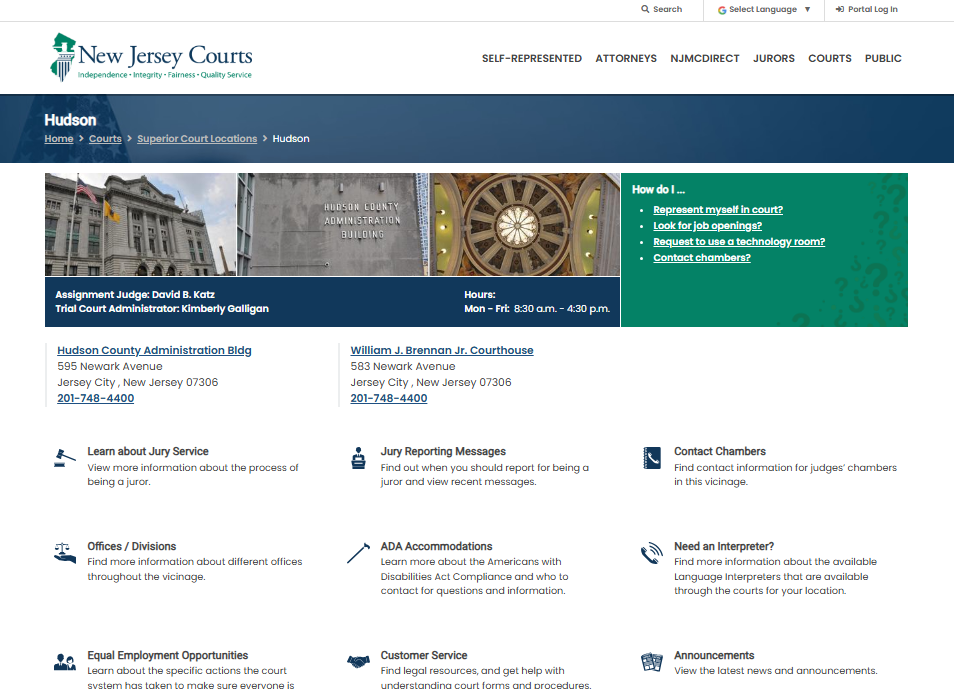
- Click Portal Log In at the top of the page
- Select Attorney Search (njcourts.gov)
- Enter the attorney’s name or license details
- View publicly available attorney information
Online access fees:
| Service | Fee | Notes |
|---|---|---|
| Viewing public records online | Free | Most civil and criminal cases |
| Downloading case documents | $0.50–$1.50 per page | Dependent on file size |
| Court filing lookup | Free | Limited to publicly available filings |
In-Person Access to Court Records
For records unavailable online, visit the Hudson County Superior Court clerk’s office:
- Address: 583 Newark Avenue, Jersey City, NJ 07306
- Hours: Monday–Friday, 8:30 AM–4:30 PM
- Requirements: Government-issued ID, completed request forms, applicable fees
In-person costs:
| Service | Fee | Notes |
|---|---|---|
| Photocopies of documents | $0.50 per page | Standard civil/criminal filings |
| Certified copies | $2–$5 per document | Required for legal or official use |
| Research assistance by staff | Varies | Optional, based on request time |
Visitors can access criminal and civil records, court filing lookup, and case types stored in the courthouse database. Staff can help with case lookup and clarify which division holds the records.
Structure of the New Jersey Superior Court System
The Superior Court of New Jersey follows a unified statewide court system that applies the same structure in every county, including Hudson County. This system places the Superior Court of New Jersey, Hudson County, within a consistent framework of divisions, judges, and judicial administration.
The statewide court system connects all county courts under one authority. As a result, cases in Hudson County follow the same legal standards, procedures, and administrative practices used across New Jersey. This consistency supports fairness and predictable court operations for residents, attorneys, and public agencies.
How the Statewide Court System Is Organized
The New Jersey Superior Court operates as a single trial-level court with county-based locations throughout the state. Each county, including Hudson County, hosts its own courthouse while remaining part of the same judicial structure. The court handles most civil, criminal, and family matters statewide.
Key features of this structure include:
- Unified authority under the New Jersey Judiciary
- Standard court rules applied across all counties
- Central judicial administration for staffing, budgeting, and policy
- Locally assigned judges serving county-specific caseloads
This setup allows Hudson County to manage local cases efficiently while staying aligned with statewide judicial priorities.
Divisions Within the Superior Court of New Jersey
The Superior Court is divided into specialized divisions that handle specific types of cases. These divisions operate in every county, including Hudson County, using the same legal scope and responsibilities.
Common divisions include:
- Criminal Division for indictable offenses
- Civil Division for lawsuits, foreclosures, and disputes
- Family Division for divorce, custody, and juvenile cases
- Special Civil Part for smaller claims and landlord-tenant matters
Each division supports focused case management, which improves court scheduling and decision-making.
Judges and Judicial Administration in Hudson County
Judges in the Superior Court of New Jersey, Hudson County, are appointed at the state level and assigned to divisions based on court needs. They follow statewide judicial standards, ethical rules, and performance expectations.
Judicial administration oversees daily court operations, staffing, and case flow. This administrative structure links Hudson County to the broader New Jersey Judiciary. At the same time, local leadership addresses county-specific demands such as population size and filing volume.
Divisions of the Hudson County Superior Court
The Superior Court of Hudson County is organized into distinct divisions that handle specific types of cases and legal matters. This structure helps the court manage workload efficiently and direct cases to the proper judicial authority.
Court dockets provide a detailed record of all scheduled hearings, filings, and case statuses within each division, helping attorneys, parties, and the public track the progress of civil, criminal, family, and special proceedings. By referencing court dockets, individuals can confirm case dates, monitor updates, and ensure compliance with procedural requirements under the Superior Court of New Jersey.
Key court divisions in Hudson County include:
- Criminal Division, which hears indictable offenses and serious charges
- Civil Division, which manages lawsuits, contract disputes, and injury claims
- Family Division, which handles divorce, custody, support, and juvenile matters
- Special Civil Part, which focuses on smaller claims and landlord-tenant cases
This division structure sets clear jurisdiction boundaries, reduces delays, and prepares readers for a closer look at each court division and its role within Hudson County.
Law Division of the Hudson County Superior Court
The Law Division of the Hudson County Superior Court handles both civil and criminal cases, providing formal procedures for trials and hearings. This division manages a broad range of disputes and serious offenses, ensuring justice through structured case flow.
The Law Division is split into two main parts: Civil Part and Criminal Part, each with its own jurisdiction, procedures, and types of cases. Civil cases involve private disputes between individuals or organizations, while criminal cases address indictable offenses prosecuted by the state. Court proceedings may involve jury trials, where a group of citizens decides the outcome, or bench trials, where a judge alone rules on the case.
Civil Part of the Law Division
The Civil Part primarily handles civil cases, including disputes over contracts, property, personal injury, and other forms of civil litigation. Cases typically start when a plaintiff files a complaint against a defendant, after which pre-trial motions, discovery, and settlement negotiations occur.
Key aspects of the Civil Part include:
- Jurisdiction: Hears cases involving claims over $15,000, as well as certain family and commercial disputes.
- Case Flow: Cases move from filing to trial unless resolved through settlement. The court schedules hearings for motions, status updates, and trial preparations.
- Trials: Civil disputes can proceed to a jury trial or a bench trial, depending on the parties’ choices.
The Civil Part ensures legal remedies such as monetary damages or injunctions are available to resolve disputes efficiently. Its focus is on fairness, timely resolution, and adherence to state civil procedure rules.
Criminal Part of the Law Division
The Criminal Part addresses criminal cases, particularly indictable offenses such as theft, assault, or fraud. Cases begin with an arrest or indictment, followed by arraignment, pre-trial motions, and the trial itself.
Key features of the Criminal Part include:
- Jurisdiction: Handles serious crimes that carry significant penalties under New Jersey law. Lesser offenses are typically handled by municipal courts.
- Case Flow: After indictment, cases may go through preliminary hearings, plea negotiations, and eventually a jury trial or bench trial if no plea is entered.
- Trial Process: The court ensures due process, allowing both defense and prosecution to present evidence, question witnesses, and make arguments before a judge or jury.
The Criminal Part emphasizes public safety and justice, managing complex litigation involving multiple parties, evidence, and legal motions. It also coordinates with law enforcement and prosecutors to maintain order and transparency in the judicial process.
Key Differences Between Law Division and Chancery Division
The Law Division and Chancery Division of the Hudson County Superior Court serve distinct purposes, handling different types of cases. Law Division focuses on legal disputes involving money or damages, while Chancery Division addresses matters requiring equitable relief, such as injunctions or disputes over property and contracts. The Law Division primarily resolves disputes where monetary compensation is the central remedy. Typical cases include personal injury claims, contract breaches, and civil lawsuits seeking damages. Judges in this division evaluate evidence, hear witnesses, and issue judgments based on statutory law. Procedures are generally more structured, with strict adherence to the rules of civil procedure.
Chancery Division, by contrast, deals with cases requiring remedies other than money. These include foreclosures, family law matters, trusts, and complex corporate disputes. Chancery judges have broader discretion to order equitable solutions, such as injunctions, specific performance, or declaratory judgments. The division also handles probate and guardianship matters, offering solutions focused on fairness rather than financial compensation alone.
| Feature | Law Division | Chancery Division |
|---|---|---|
| Primary Focus | Legal remedies (damages) | Equitable remedies (injunctions, specific performance) |
| Case Examples | Personal injury, contract disputes, tort claims | Foreclosures, trusts, corporate disputes, family law |
| Judicial Approach | Strict application of law | Flexible, equity-based decisions |
| Common Procedures | Jury trials, civil motions | Strict application of the law |
Types of Cases Handled by Hudson County Superior Court
Hudson County Superior Court handles a wide range of legal disputes, including both criminal cases and civil cases. This court serves as the primary venue for serious matters that require formal judicial proceedings. The Superior Court is organized to manage multiple trial types and case categories, ensuring each legal matter receives the proper attention and procedure. Criminal cases in Hudson County cover offenses such as theft, assault, drug-related crimes, and other violations of state law. These cases are prosecuted by the state and may result in penalties ranging from fines to incarceration, depending on the severity of the offense.
On the other hand, civil cases involve disputes between private parties, such as contract disagreements, property claims, personal injury lawsuits, and family law matters. The court oversees these disputes to provide fair resolutions, which may include monetary compensation, injunctions, or specific performance orders. Civil litigation often involves extensive legal documentation and may require mediation or multiple hearings before a final judgment is rendered.
Criminal Cases
- Felonies: Serious crimes like burglary, robbery, and major drug offenses.
- Misdemeanors: Lesser offenses, including minor theft or disorderly conduct.
- DUI and traffic violations: Cases involving driving under the influence or repeated traffic infractions.
Criminal proceedings follow strict procedural rules, and defendants have rights to legal representation, jury trials, and appeals when applicable.
Civil Cases
- Contracts and business disputes: Conflicts over agreements, loans, or business operations.
- Torts and personal injury: Claims for accidents, negligence, or harm caused by another party.
- Family law matters: Divorce, child custody, and support issues.
Civil cases often require documentation such as pleadings, motions, and evidence submissions. The court may encourage settlements through alternative dispute resolution before moving to a full trial.
Judges and Court Administration
Hudson County Superior Court is overseen by experienced judges and supported by a dedicated court administration team. Judicial officers ensure cases are handled fairly, efficiently, and in accordance with New Jersey law. The court’s judges preside over civil, criminal, and family matters, making decisions based on state statutes and case law. Each judge is assigned to specific divisions, such as the Law Division or Chancery Division, to manage cases effectively. Their responsibilities include ruling on motions, conducting trials, and issuing judgments that uphold justice while maintaining public trust.
Court administration plays a vital role in the smooth operation of the courthouse. This team manages scheduling, maintains court records, oversees filings, and provides support to judges and staff. Efficient administration helps reduce delays, ensures compliance with procedural rules, and facilitates clear communication between the public and judicial officers.
Key personnel in court administration include:
- Clerks of the Court: Handle filings, maintain official records, and assist the public with case-related inquiries.
- Court Managers: Coordinate daily operations and manage staff workflow.
- Judicial Assistants: Support judges with research, scheduling, and case documentation.
Together, judges and court administration form a structured system that ensures transparency, fairness, and accountability in Hudson County’s judicial process. Their combined expertise maintains the court’s credibility and reinforces trust in its decisions.
Courthouse Locations & Jurisdiction
The Hudson County courthouse system serves all major legal matters across Hudson County, New Jersey, including civil, criminal, and family cases. Its main Superior Court offices are in Jersey City, with jurisdiction that covers the entire county.
At the heart of the county’s judicial services is the Hudson County Administration Building and the William J. Brennan Jr. Courthouse, both located on Newark Avenue in Jersey City. These locations handle most filings and hearings for the Superior Court, such as trials, case management, and court services. Municipal courts in other localities, like Bayonne and Secaucus, manage smaller matters such as traffic offenses and local ordinance cases within their jurisdiction boundaries.
Primary Hudson County courthouse contact details:
- Superior Court – Hudson County Administration Building
595 Newark Avenue, Jersey City, NJ 07306
Phone: (201) 748-4400 - Superior Court – William J. Brennan Jr. Courthouse
583 Newark Avenue, Jersey City, NJ 07306
Phone: (201) 748-4400
Secondary municipal court locations nearby:
- Bayonne Municipal Court
630 Avenue C, Bayonne, NJ 07002
Phone: (201) 858-6934 - Secaucus Municipal Court
1203 Paterson Plank Road, Secaucus, NJ 07094
Phone: (201) 330-2056
For court records, filings, or Superior Court Clerk services, the William J. Brennan Jr. Courthouse at 583 Newark Avenue is often the point of contact.
Email & procedural contacts:
- General court questions and procedural help can be sent to the Hudson Court User Resource Center email: HudsonHelp.Mailbox@njcourts.gov (Jersey City)
- Jury service inquiries use Hudjury.Mailbox@njcourts.gov with phone support at (201) 748-4400 ext. 60560.
These locations follow clearly defined jurisdiction boundaries so that cases are heard in the correct venue. Civil, family, and serious criminal matters go through the Superior Court in Jersey City, while local issues like parking tickets and municipal code violations stay within local city courts. This structured approach helps residents find the right court locations and contact points for their legal needs.
(FAQ) About Superior Court
The Hudson County Superior Court handles criminal, civil, family, and probate matters, providing a structured forum for legal disputes within the county. It ensures each case follows New Jersey law while offering resources for residents, attorneys, and self-represented parties to navigate filings, hearings, and court schedules effectively.
How does the Superior Court function?
The Superior Court operates through different divisions, with judges overseeing proceedings to maintain fairness and adherence to legal rules. Court staff manage filings, schedule hearings, and maintain records, while many services—such as case status checks and docket information—are available online, helping both attorneys and the public stay informed throughout a case.
Types of Cases Handled?
Hudson County Superior Court addresses a wide variety of matters, including civil disputes like contract and property issues, criminal cases ranging from indictable offenses to serious felonies, family law cases involving divorce, custody, or child support, and probate matters such as wills, estate administration, and guardianships. This structure allows the court to handle each case efficiently while ensuring procedural fairness and clarity for all parties.
How Can I Attend a Hearing?
Anyone interested in attending a hearing must check the court calendar for dates and times, as some sessions may be limited to participants only. Public hearings generally allow observers, but visitors should arrive early, follow court security protocols, and respect courtroom procedures to ensure the process runs smoothly.
What Are the Filing Procedures for a Case?
Filing a case begins with submitting the required forms to the appropriate division, along with any applicable fees. Each division has specific forms and instructions, and staff can provide guidance. Electronic filing options are available for certain case types, streamlining the submission process and helping parties avoid delays.
How Do I Obtain Court Records?
Court records can be requested through the Clerk’s Office, which provides access to documents for civil, criminal, and family matters. Some records are available online, while others require an in-person visit. Proper identification and a clear description of the documents needed help ensure a smooth request process.